

Monitor Riser for Gigabyte Aorus FV43U
Design and build two compact risers (one per pair of monitor feet: left and right) to raise a Gigabyte Aorus FV43U monitor by 190 mm (19 cm), allowing a laptop to sit open in front of the screen, while remaining stable on a standing desk that exhibits some wobble.
Key constraints
Section titled “Key constraints”- Minimal footprint (significantly less than current 380 mm depth)
- Very high lateral stability
- No permanent modification of the monitor
- Clean, furniture-grade appearance
- Buildable with woodworking tools + consumer 3D printer
Monitor & Desk Context
Section titled “Monitor & Desk Context”- Monitor weight (with stand): ~10 kg total (~5 kg per foot)
- Stand type: two independent metal feet
- Desk depth: 900 mm
- Desk type: height-adjustable standing desk (prone to small lateral oscillations)
- Primary instability risk: micro-movement and walking, not static tipping
Final Riser Geometry (Per Side — Paired Feet)
Section titled “Final Riser Geometry (Per Side — Paired Feet)”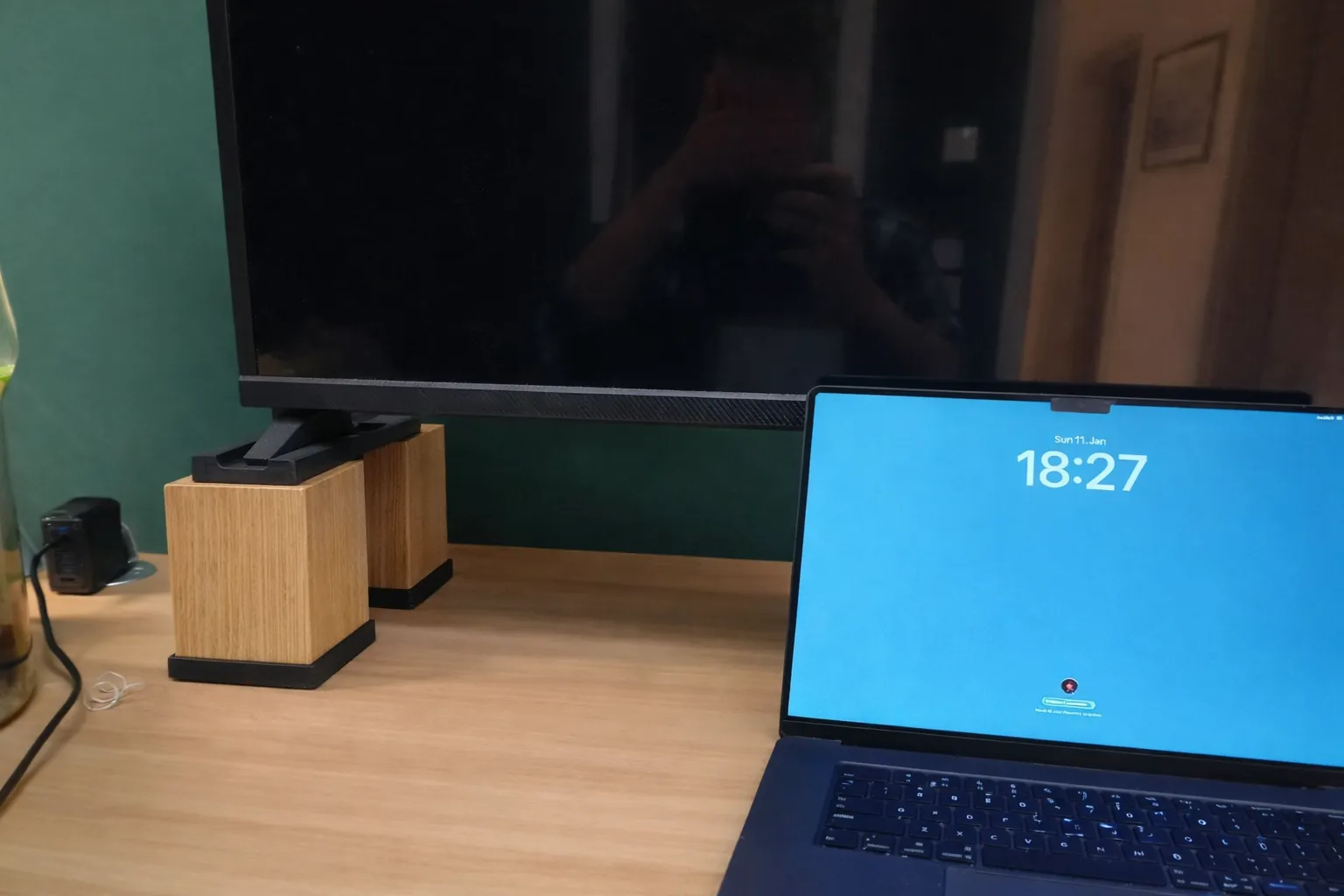
Overall Dimensions
Section titled “Overall Dimensions”- Height: 190 mm (19 cm, fixed)
- Width (left–right): 190 mm
- Depth (front–back): 300 mm (30 cm) — combined riser depth for each paired-foot riser
This footprint provides strong resistance to dynamic sway for each paired-foot riser; depth trade-offs prioritize supporting both feet per riser while keeping the riser compact compared to the original full stand depth.
Structural Layout
Section titled “Structural Layout”Layered vertical stack (bottom → top):
-
Bottom damping layer
- 3–5 mm rubber or cork–rubber composite
- Shore A ≈ 50–60
- Covers ≥80% of base area
-
Wooden structural core
- Height: 165 mm
- Width: 190 mm
- Depth: 300 mm
- Material:
- Hardwood (oak, beech, maple), or
- Laminated birch plywood
- Chamfered edges (~5 mm) to reduce visual bulk
-
3D-printed locking cradle
- Height: 20 mm
- Width: ~160 mm (contour to pair spacing)
- Depth: ~280 mm (to accommodate paired feet within the combined riser)
- Material: PLA+ (non-structural)
- Mechanically bonded to wood (VHB tape or screws from below)
Total height: 190 mm (19 cm)
Locking Mechanism (Critical Feature)
Section titled “Locking Mechanism (Critical Feature)”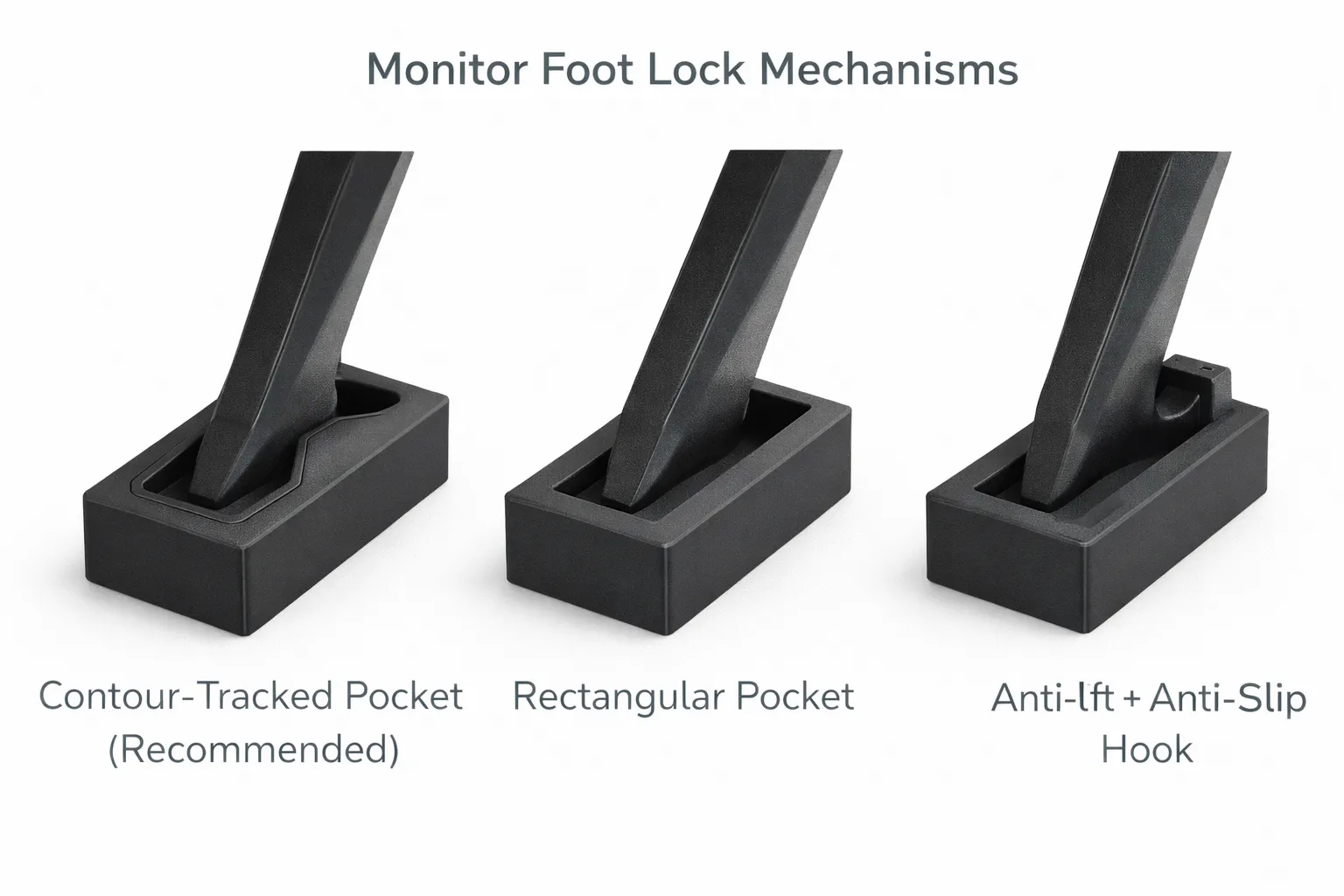
Shallow mechanical foot pocket (parking-curb style)
Geometry
Section titled “Geometry”- Pocket depth: 4–5 mm
- Wall thickness: ≥4 mm
- Clearance: +0.5 mm per side relative to monitor foot
- Rear stop: 6 mm vertical lip
- Bottom of pocket: flat (monitor foot rests on solid surface)
Function
Section titled “Function”- Prevents lateral sliding in all directions
- Blocks forward/backward movement during desk oscillation
- Does not trap the foot vertically (lift-off removal remains possible)
- Relies on geometry, not friction alone
3D Printing Parameters (PLA+)
Section titled “3D Printing Parameters (PLA+)”- Print orientation: flat on build plate
- Walls: 4–5 perimeters
- Infill: 25–30% (gyroid or cubic)
- Layer height: 0.2 mm
- Internal fillets: 1–2 mm at pocket corners
PLA+ is acceptable because it carries no bending load and only experiences compression and contact forces.
Stability Strategy (Standing Desk Optimized)
Section titled “Stability Strategy (Standing Desk Optimized)”- Wide stance (190 mm) resists lateral acceleration
- Reduced lever arm from targeted depth (300 mm per combined riser) balances compactness and paired-foot support to minimize oscillation leverage
- Bottom rubber layer damps desk motion and prevents “walking”
- Mechanical foot lock eliminates slow creep over time
Material Choice Rationale
Section titled “Material Choice Rationale”- Wood (preferred):
- High damping
- Light enough for standing desk motors
- Easy to shape and iterate
- Concrete: explicitly avoided due to poor dynamic behavior, high mass, and desk wear risk
Status
Section titled “Status”This design is considered:
- Mechanically safe
- Optimized for minimal bulk
- Ready for CAD modeling and fabrication
- Suitable for further refinement (visual tapering, material finish, cradle contouring)
Possible Next Iterations
Section titled “Possible Next Iterations”- CAD-ready dimensioned drawings
- Exact cradle contour matching the FV43U foot
- Further depth reduction trade-off analysis
- Visual slimming (tapers, shadow grooves)
- STL generation for the cradle