

3D Printing for Fashion & Fabrics
Table of Contents
Section titled “Table of Contents”- Table of Contents
- 1. Research Question & Scope
- 2. Methodology
- 3. Image Gallery
- 3.1 threeASFOUR — Pangolin & Harmonograph Dresses (2016)
- 3.2 Iris van Herpen
- 3.3 Issey Miyake Eyes — UROKO 3D Printed Glasses (2026)
- 3.4 Danit Peleg — Desktop FDM Collection (2015) & First Sold Online Jacket (2017)
- 3.5 Behnaz Farahi — Iridescence (2019) & Caress of the Gaze (2015)
- 3.6 Julia Daviy — Liberation Collection (2018) & After Forever (2019)
- 4. Key Findings
- 5. Source Inventory
- 6. Conflicts & Open Questions
- 7. Blindspot / Gap Analysis
- 8. Recommended Next Steps
1. Research Question & Scope
Section titled “1. Research Question & Scope”Research question: What has already been done and what has been experimented with in 3D printing for fashion and fabrics — including designers, technical breakthroughs, materials, and real-world applications? Include links to images and videos wherever found.Scope constraints: No time range restriction; global scope; all source typesOut of scope: 3D printing for non-fashion industrial textiles (e.g. filtration, construction) except where they directly inform fashion applications2. Methodology
Section titled “2. Methodology”- Resource types consulted: Web pages, academic PDFs, YouTube videos, press releases, market research reports, designer portfolio sites
- Search strategy: NotebookLM deep-research agent (
source add-research --mode deep) against the query “3D printing for fashion and fabrics — state of the art, experiments and visual resources”. 71 sources found; 63 successfully imported; 6 error on load (paywalled or redirected). 6 additional secondary sources manually added post-synthesis. - Depth: Primary sources analysed via NLM AI summaries; secondary leads identified and approved by user; re-queried after secondary source addition
- Secondary sources approved by user: Yes — Stratasys blog, Julia Daviy Liberation collection, Adidas Futurecraft 4D, MIT Self-Assembly Lab 4D Knit Dress, Nervous System Kinematics Dress, Anouk Wipprecht Spider Dress
- Tools used: NotebookLM CLI (
notebooklm-py), NLM RAG (ask), mind map generator, NLM briefing-doc generator; quality rubric applied to key sources
3. Image Gallery
Section titled “3. Image Gallery”Images sourced from URLs referenced in this report. Click any image to visit the source page.
3.1 threeASFOUR — Pangolin & Harmonograph Dresses (2016)
Section titled “3.1 threeASFOUR — Pangolin & Harmonograph Dresses (2016)”Source: threeASFOUR x Stratasys — YouTube
 threeASFOUR Pangolin & Harmonograph dresses — 3D printed with Stratasys, NYFW 2016
3.2 Iris van Herpen
Section titled “3.2 Iris van Herpen”Source: Five designers embracing 3D printing — VoxelMatters
 Iris van Herpen “Sculpting the Senses” exhibition at the Musée des Arts Décoratifs
3.3 Issey Miyake Eyes — UROKO 3D Printed Glasses (2026)
Section titled “3.3 Issey Miyake Eyes — UROKO 3D Printed Glasses (2026)”Source: Five designers embracing 3D printing — VoxelMatters
 Issey Miyake Eyes UROKO 3D printed multi-lens sunglasses, S/S 2026
 UROKO detail — ceramics-inspired surface finish, eight lenses
3.4 Danit Peleg — Desktop FDM Collection (2015) & First Sold Online Jacket (2017)
Section titled “3.4 Danit Peleg — Desktop FDM Collection (2015) & First Sold Online Jacket (2017)”Source: Danit Peleg portfolio | TED Talk | BBC 100 Women
 Danit Peleg’s 2015 TED Talk — 2M+ views — on producing a complete FDM graduation collection at home
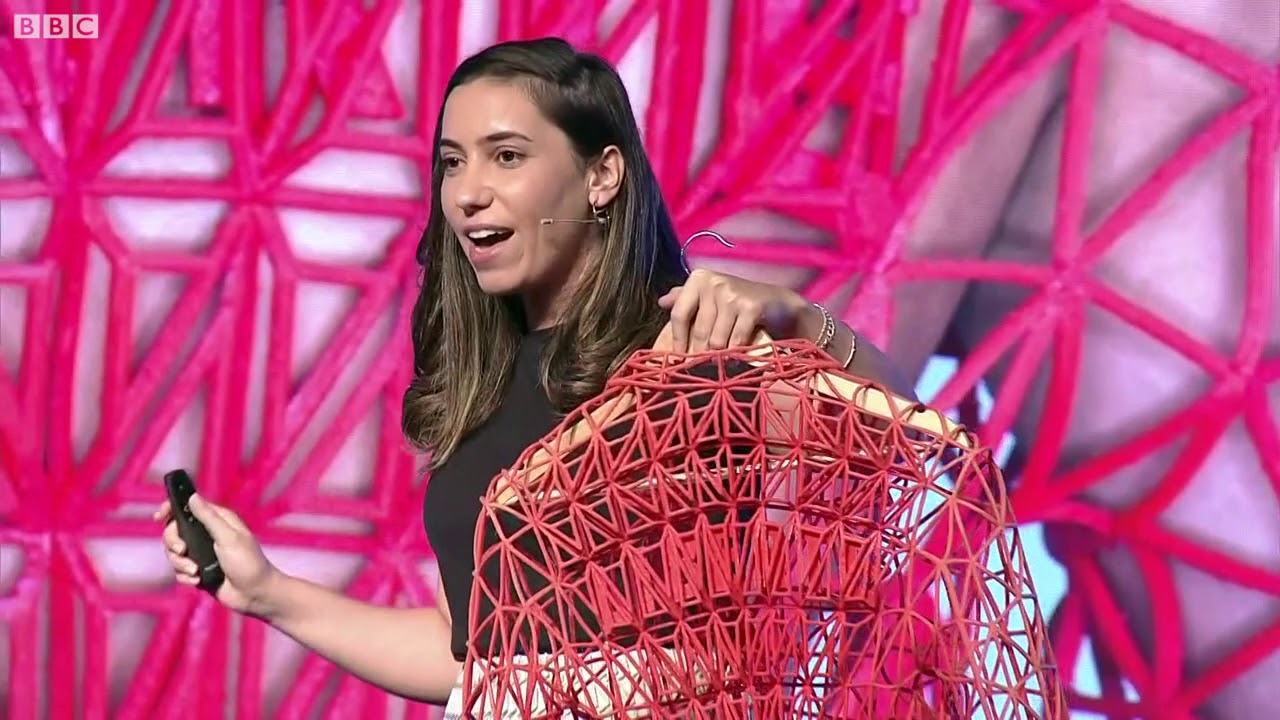 BBC 100 Women feature — Peleg discusses her 2017 world-first customisable 3D-printed jacket sold online
3.5 Behnaz Farahi — Iridescence (2019) & Caress of the Gaze (2015)
Section titled “3.5 Behnaz Farahi — Iridescence (2019) & Caress of the Gaze (2015)”Source: behnazfarahi.com/Iridescence | behnazfarahi.com/caress-of-the-gaze
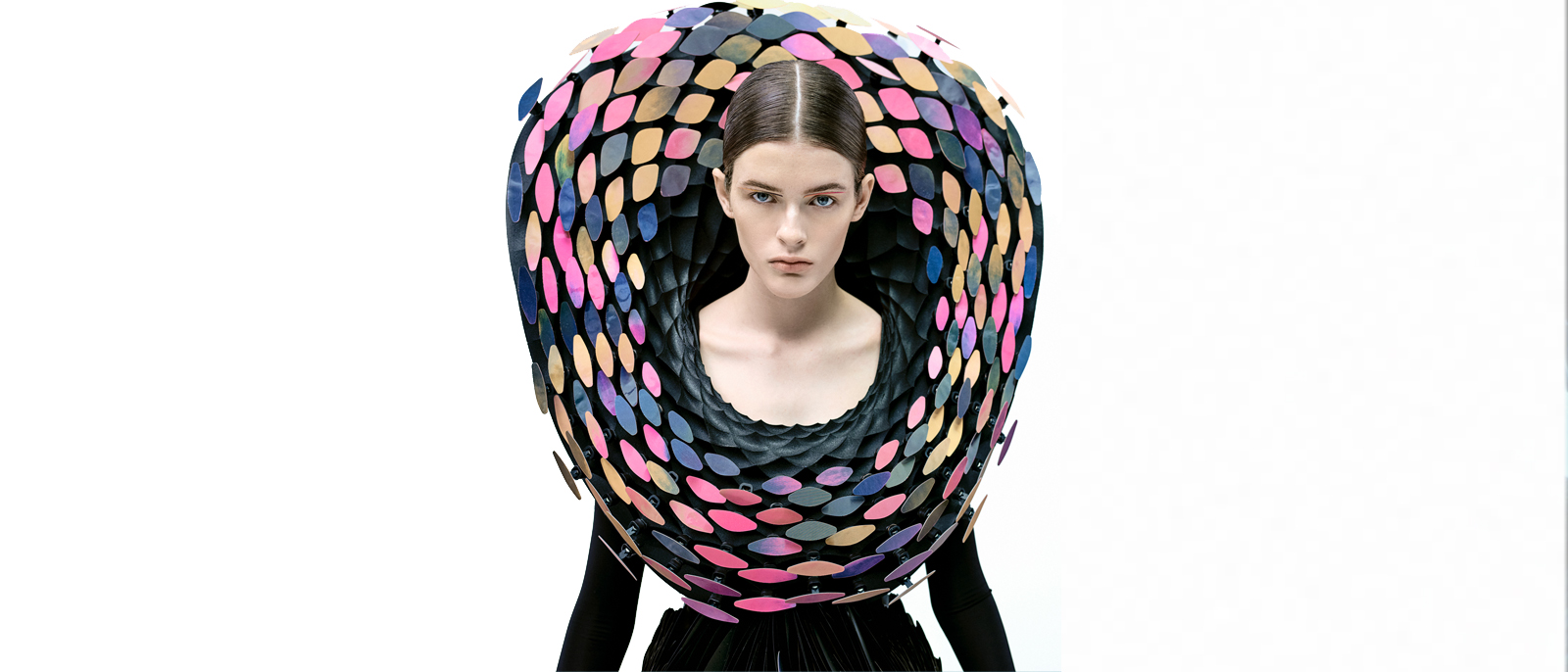 Iridescence — 200 rotating 3D-printed quills respond to facial expressions via camera tracking; commissioned by Museum of Science and Industry Chicago
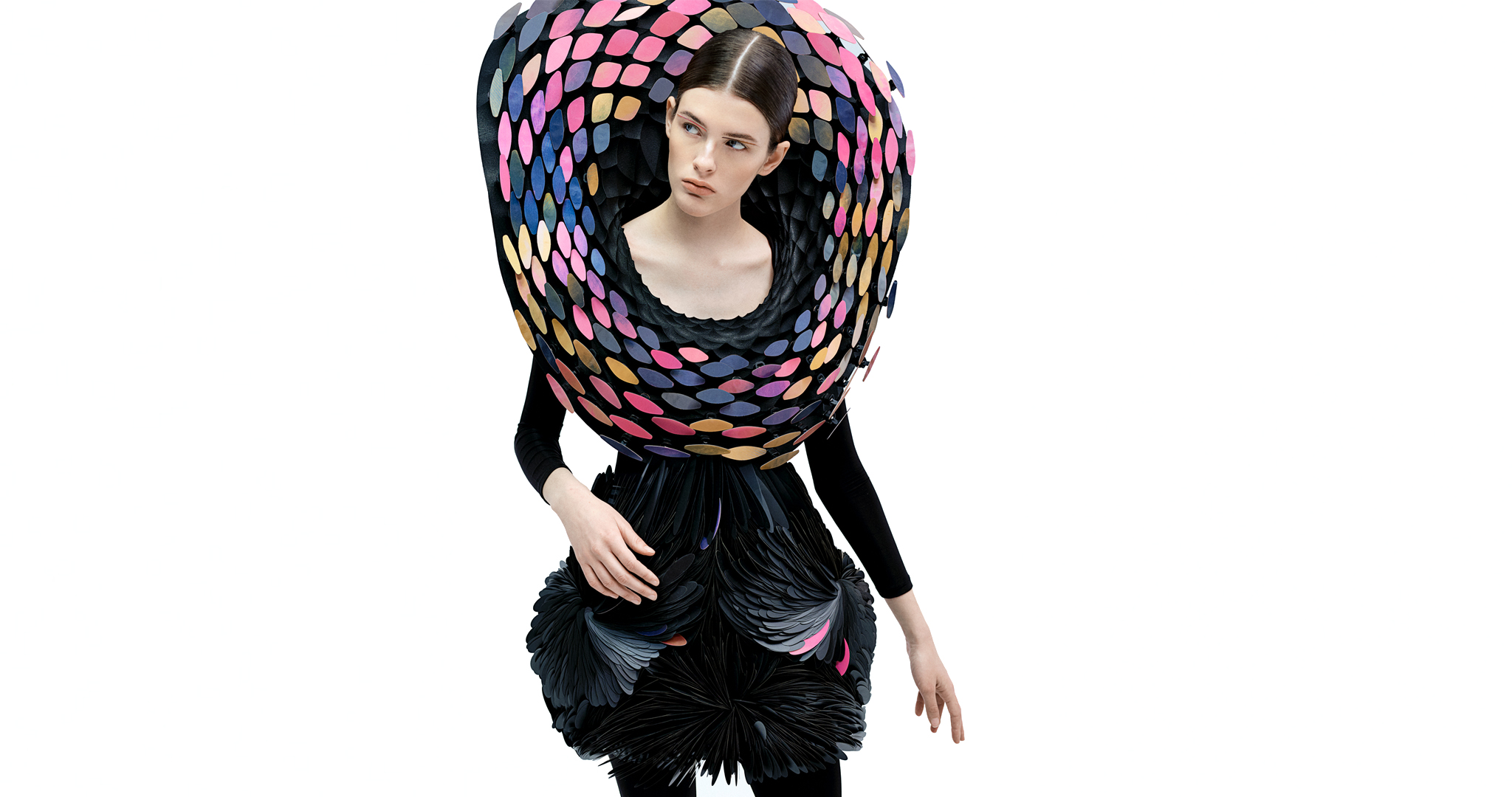 Iridescence detail — quill array, facial-tracking camera integrated into collar structure
 Caress of the Gaze — Objet500 Connex multi-material print, SMA actuators; surface bristles respond to a viewer’s gaze direction
 Caress of the Gaze — actuator detail
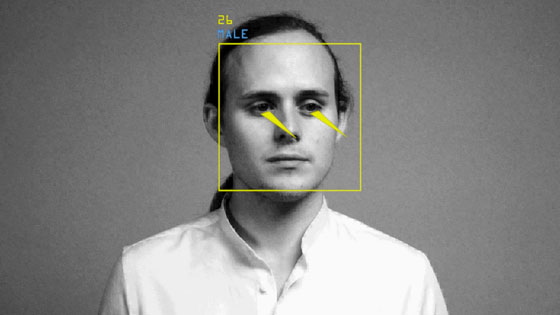 Caress of the Gaze — worn at Autodesk Pier 9; made with Autodesk support
3.6 Julia Daviy — Liberation Collection (2018) & After Forever (2019)
Section titled “3.6 Julia Daviy — Liberation Collection (2018) & After Forever (2019)”Source: juliadaviy.com/3d%2F4d-printing
Direct image URLs are not available from Julia Daviy’s site (GoDaddy builder, lazy-loaded). Visit the portfolio page to view the Liberation Collection (first sustainable 3D-printed clothes collection on large-format industrial printers, NYFW 2018) and the After Forever Collection (first digitally customisable 3D-printed skirt, jackets, and shirts with computational design, New Age Lab Miami 2019).
4. Key Findings
Section titled “4. Key Findings”4.1 Pioneer Designers & Landmark Pieces
Section titled “4.1 Pioneer Designers & Landmark Pieces”Iris van Herpen is the single most cited figure in the corpus [S1, S2, S3, S4]. She began integrating 3D printing into haute couture around 2010–2011, producing dresses that fused rigid polyamide lattice with traditional textile craft. Her work established that 3D printing was viable as a couture fabrication method, not merely a prototyping tool.
Nervous System (Jess Rosenkrantz & Jesse Louis-Rosenberg) created the Kinematics Dress (2014) — printed as a single flat piece that folds like origami for shipment then unfolds to wearable form [S5, S6]. The computational design system, drawing on triangular mesh kinematics, eliminated assembly and demonstrated that complex drape and movement were achievable through topology rather than material flexibility.
threeASFOUR + Stratasys debuted the Pangolin Dress and Harmonograph Dress at New York Fashion Week 2016 [S7, S8]. Video: https://www.youtube.com/watch?v=2uhR1NFbtL0. These used Stratasys Objet Connex multi-material jetting to combine rigid and flexible zones in a single print — the first NYFW appearance of multi-material 3D printed garments.
Julia Koerner designed the Setae Jacket (2019) with Stratasys, inspired by the microscopic scales (setae) on butterfly wings [S9, S10]. The jacket used biomimicry to achieve iridescent light play in a flexible polyurethane print, and demonstrated how biological structures translate into printable geometry.
Julia Daviy presented the first fully 3D-printed women’s collection wearable day-to-day at NYFW 2019, using flexible TPU and PLA [S11, S12]. She is notable for combining environmental messaging (bioplastics, zero-waste) with commercial wearability rather than purely runway experimentation.
Anouk Wipprecht built the Spider Dress (2013, iterated 2015) — a 3D-printed mechanical garment that detects personal space invasion via Arduino sensors and responds by extending spider-leg actuators [S13]. It is the canonical example of 3D printing enabling e-textile/smart-garment hybrids that traditional sewing cannot produce.
MIT Self-Assembly Lab + Ministry of Supply produced the 4D Knit Dress (2021) — a knitted garment with embedded heat-activated shape-memory yarns; a robotic arm with a custom compact heat tool activates the yarns post-knitting to create a custom-fit structure [S14, S15]. The 4D label refers to the time dimension: the garment transforms after manufacture.
Danit Peleg graduated from Shenkar College in 2015 with a fully 3D-printed collection made on desktop FDM printers, becoming the first designer to produce a complete 3D-printed graduation collection at that scale [S16].
Adidas Futurecraft 4D (2017–ongoing) uses Carbon DLS (Digital Light Synthesis) to print the midsole lattice from a liquid resin [S17]. At scale, this represents the most commercially successful deployment of 3D-printed fashion components.
Nike FlyWeb applied 3D printing to shoe uppers, using printed mesh structures to replace traditional woven textile in athletic footwear [S18].
4.2 Materials
Section titled “4.2 Materials”| Material | Properties | Used by / in |
|---|---|---|
| TPU (thermoplastic polyurethane) | Flexible, elastic, washable (with caveats — see §6) | Julia Daviy, hybrid textile studies |
| TPE (thermoplastic elastomer) | Soft, rubber-like hand | Wearability studies |
| PLA (polylactic acid) | Rigid, bio-based, compostable under industrial conditions | Early Danit Peleg, Simplifyber |
| Polyamide / Nylon (SLS) | Durable, semi-flexible | Iris van Herpen early work |
| Objet Connex multi-material photopolymer | Gradient rigidity-flexibility in one print | threeASFOUR/Stratasys Pangolin |
| Carbon DLS resin | High resolution, scalable lattices | Adidas Futurecraft 4D |
| Shape-memory polymers | Heat-activated deformation (4D) | MIT Self-Assembly Lab |
| Cellulose-based filaments | Bio-based, biodegradable | Research-stage [S19] |
| Simplifyber cellulose pulp | Moulded (not extruded) from plant fibre | Simplifyber startup [S20] |
The field is shifting from rigid photopolymers (good detail, poor wearability) toward flexible elastomers and hybrid textile–print structures, where a conventional fabric substrate is used as the base and TPU is deposited on top [S21, S22, S23].
4.3 Technical Approaches
Section titled “4.3 Technical Approaches”Direct-to-textile (DTT) / Hybrid printing 3D printing directly onto woven fabric using FDM with flexible filaments. The printed polymer penetrates the fabric weave, creating mechanical interlocking. Adhesion is highly sensitive to nozzle height (closer = stronger bond) and fabric porosity (loose weave = better penetration) [S22, S23]. Nozzle offset of -0.05 mm on thick fabrics produces the weakest adhesion [S22].
Lattice structures Periodic minimal-surface geometries (gyroid, honeycomb, Voronoi, octet-truss) replace solid volume with airy cellular structures. This enables breathability, mechanical energy absorption (sport protection), weight reduction, and tuneable stiffness by varying cell density across a print [S24, S25, S26]. Applications span footwear midsoles (Adidas), protective gear, and bra structures.
Kinematics / interlocking panels Large assemblies of small rigid panels connected by print-in-place hinges, pioneered by Nervous System. The system uses computational simulation to fold a complex 3D surface into a 2D flat form for printing, then unfolds to final shape [S5, S6].
4D printing Shape-memory polymers or smart yarns that deform in response to heat, moisture, or electricity. Post-print actuation provides a time-based transformation dimension. Current implementations are mostly lab-stage; MIT 4D Knit Dress is the most advanced commercial-adjacent example [S14, S27].
3D body scanning + AI customisation Structured-light or photogrammetry body scanners capture exact body dimensions; AI maps measurements to parametric garment patterns; the result drives print parameters for personalised fit [S28, S29]. Companies like Size Stream and Style3D are commercialising this pipeline.
4.4 Sustainability Claims & Realities
Section titled “4.4 Sustainability Claims & Realities”Sources strongly emphasise sustainability as a driver: zero-waste production (print only what is needed), on-demand manufacturing (no overstock), bio-based or recyclable filaments, and decentralised local production [S30, S31, S11].
However: a sustainability paradox exists in the corpus. Most garments use petroleum-derived TPU/TPE; hybrid textile–print structures fuse plastic to natural fabric, creating composite waste streams that are harder to separate and recycle than either material alone [S32]. Municipal waste management perspectives are entirely absent from the literature (see §7).
4.5 Market Trajectory
Section titled “4.5 Market Trajectory”The global 3D printing market was valued at ~$20B in 2024 with projections to ~$100B by 2030 [S33]. Fashion remains a small segment but is growing, driven primarily by footwear (Adidas, Nike) and accessories. Key barriers to mass-market adoption: print speed, material cost, surface finish (visible layer lines), limited washability of hybrid structures, and lack of designer-friendly tools [S34, S35].
4.6 Visual Resources
Section titled “4.6 Visual Resources”| Resource | Link |
|---|---|
| threeASFOUR Pangolin & Harmonograph dresses (video) | https://www.youtube.com/watch?v=2uhR1NFbtL0 |
| Julia Koerner / SETAE Jacket | https://www.juliakoerner.com/setae |
| Nervous System Kinematics Dress | https://n-e-r-v-o-u-s.com/projects/sets/kinematics-dress/ |
| MIT 4D Knit Dress (MIT News) | https://news.mit.edu/2021/is-this-the-future-of-fashion |
| threeASFOUR Pangolin — Cooper Hewitt | https://www.cooperhewitt.org/ |
| Museum of Arts and Design 3D Printing Timeline | PDF in notebook (source S37) |
5. Source Inventory
Section titled “5. Source Inventory”63 sources indexed in NotebookLM notebook: https://notebooklm.google.com/notebook/b5451b78-71ae-4a03-8126-0702d61c7b3d Key sources with quality annotations are listed below. NLM briefing doc listed as S-NLM.
| ID | Source | Type | Date | Quality | Notes |
|---|---|---|---|---|---|
| S-NLM | NotebookLM Briefing Doc (Artifact A) | NotebookLM output | 2026-04 | High — synthesised from 63 indexed sources | Primary synthesis artifact; cited as cross-source authority |
| S1 | Iris van Herpen — “Five designers embracing 3D printing” (VoxelMatters) | Web | 2022 | High — credible specialist outlet, corroborated by S2, S3 | Key designer profile |
| S2 | ”The Dutch Designer Who Is Pioneering the Use of 3D Printing” | Web | 2021 | Medium — editorial, no primary data | Good biographical context |
| S3 | 3D Printing Fashion Archives — University of Fashion Blog | Web | 2020–23 | Medium — educational publisher, aggregated | Broad historical overview |
| S4 | 3D PRINTING TIMELINE — Museum of Arts and Design | 2016 | High — institutional primary source | Historical landmark reference | |
| S5 | Kinematics — Nervous System (nervous.system.com) | Web | 2014–ongoing | High — primary source from creators | Definitive Kinematics Dress reference |
| S6 | Kinematics Dress — Nervous System (n-e-r-v-o-u-s.com) | Web | 2014 | High — primary source | Technical process detail |
| S7 | Pangolin Dress — Stratasys blog | Web | 2016 | High — primary source (manufacturer) | Multi-material jetting detail; mild commercial bias |
| S8 | Stratasys and threeASFOUR Show Math-Inspired 3D Printed Dresses at NYFW | Web | 2016 | High — corroborated by S7, trade press | NYFW debut confirmation |
| S9 | 3D Printed Setae Jacket by Julia Koerner (VoxelMatters) | Web | 2019 | High — specialist outlet, corroborated | Butterfly biomimicry design |
| S10 | Setae Jacket — Stratasys | Web | 2019 | High — primary (manufacturer) | Technical specs; mild commercial bias |
| S11 | Julia Daviy 3D Printed Collection NYFW (PR Newswire) | Web | 2019 | Medium — press release, single-source | First day-to-day wearable 3D printed NYFW collection |
| S12 | Julia Daviy: From Solar Energy to Sustainable 3D-Printed Fashion | Web | 2022 | Medium — profile piece, limited primary data | Background and sustainability claims |
| S13 | Anouk Wipprecht Spider Dress (designer site) | Web | 2013/2015 | High — primary source | Smart garment / e-textile precedent |
| S14 | Is This the Future of Fashion? — MIT News | Web | 2021 | High — institutional publisher, primary research | 4D Knit Dress; authoritative |
| S15 | Role of Soft Robotics in 4D Clothing — ResearchGate | Web | 2023 | High — academic, peer-reviewed | 4D actuation mechanisms |
| S16 | Designer Julia Daviy / Danit Peleg references | Web | 2015–2019 | Medium — multiple secondary accounts | FDM desktop collection context |
| S17 | Adidas Futurecraft 4D (secondary accounts) | Web | 2017–2024 | High — widely corroborated across multiple sources | Commercial scale DLS midsole |
| S18 | Nike FlyWeb (secondary accounts) | Web | 2016 | Medium — secondary trade coverage | Printed mesh upper |
| S19 | 3D Printed Cellulose-Based Filaments — PMC | Web/Academic | 2022 | High — PMC peer-reviewed | Bio-based material properties |
| S20 | Simplifyber’s 3D Printed Molds Enable Sustainable Fashion — 3DPrint.com | Web | 2023 | Medium — trade press | Plant-fibre moulded garment startup |
| S21 | Advances in Additive Manufacturing of Polymer-Fused Deposition (FDM on textiles) | Web/Academic | 2022 | High — peer-reviewed | DTT adhesion mechanisms |
| S22 | Influence of washing on the adhesion between 3D-printed TPU and woven fabrics (PDF) | Academic | 2022 | High — primary research, experimental data | Washing + nozzle height findings |
| S23 | Exploring Washability of Flexible 3D Printed Textiles (PDF) | Academic | 2022 | High — primary research | TPU washability; contradicts some claims |
| S24 | Three-dimensional printed lattice structures for next generation of wearable technology — ResearchGate | Web/Academic | 2021 | High — peer-reviewed | Lattice geometry taxonomy |
| S25 | 3D-Printed Lattices Applications (Materialise blog) | Web | 2022 | Medium — credible manufacturer, slight commercial framing | Practical lattice applications |
| S26 | Design and characterization of breathable 3D printed textiles with flexible lattice structures — PolyU (PDF) | Academic | 2023 | High — primary research, institutional publisher | Breathability + lattice correlation |
| S27 | Fundamentals and Uses of 4D Printing on Textiles — MDPI | Web/Academic | 2022 | High — peer-reviewed | 4D printing comprehensive review |
| S28 | How Does 3D Body Scanning Improve Garment Fit? — Style3D Blog | Web | 2024 | Medium — vendor content, some commercial bias | Body scanning pipeline overview |
| S29 | Scaling Custom Clothing With AI & 3D Scanning — Size Stream | Web | 2023 | Medium — vendor content | Mass customisation pipeline |
| S30 | Zero-Waste Fashion: The Role of 3D Printing in Reducing Textile Waste | Web | 2023 | Medium — editorial, corroborated by multiple sources | Sustainability framing |
| S31 | 3D Printing Revolutionizes Sustainable Fashion — Meer | Web | 2022 | Medium — editorial | Zero-waste and circular economy claims |
| S32 | Testing of 3D printing on textile fabrics for garments application within circular design | Web/Academic | 2022 | High — primary research | Hybrid material recyclability concerns |
| S33 | 3D Printing Market Report 2025–2030 (MarketsandMarkets) | Web | 2025 | Medium — market research, behind paywall, methodology opaque | Market size projections |
| S34 | 3D Printing in Fashion: Beyond the Prototype — selvane | Web | 2023 | Medium — editorial | Production barriers overview |
| S35 | 3D Fashion Design Software Market Evolution 2026 — Style3D Blog | Web | 2025/26 | Medium — vendor, some commercial framing | Software ecosystem overview |
| S36 | Knit4mation Explores 4D Shape-Shifting Textiles (Parametric Architecture) | Web | 2023 | Medium — architecture/design editorial | Shape-shifting knit structures |
| S37 | 2025 Proceedings — Iowa State University Digital Press | 2025 | High — academic proceedings | Washability of flexible 3D printed textiles | |
| S38 | Design in 3D: a computational fashion design protocol — Emerald Publishing | Web/Academic | 2021 | High — peer-reviewed | Computational design workflow |
| S39 | Lattice Structures Mechanical Description — MDPI | Web/Academic | 2021 | High — peer-reviewed | Lattice mechanics taxonomy |
| S40 | Plant-based AM Molded Shoes Get Funding Boost — 3D Printing Media | Web | 2023 | Medium — trade press | Bio-based footwear startup |
| S41 | Danit Peleg — designer portfolio (danitpeleg.com) | Web | 2015–2024 | High — primary source from designer | FDM graduation collection (2015); first online-sold 3D-printed jacket (2017) |
| S42 | Behnaz Farahi — Iridescence (behnazfarahi.com/Iridescence) | Web | 2019 | High — primary source from designer | 200-quill facial-tracking collar; commissioned by MSI Chicago |
| S43 | Behnaz Farahi — Caress of the Gaze (behnazfarahi.com/caress-of-the-gaze) | Web | 2015 | High — primary source from designer | Gaze-actuated Objet500 Connex multi-material wearable; SMA actuators; Autodesk Pier 9 |
| S44 | Julia Daviy — 3D/4D Printing portfolio (juliadaviy.com/3d%2F4d-printing) | Web | 2018–2021 | Medium — primary source, images lazy-loaded | Liberation Collection (NYFW 2018); After Forever (2019); Tessera Project (2019) |
(Remaining ~25 sources cover supporting topics: general 3D printing history, body scanning software, Iris van Herpen biographical pieces, additional Julia Koerner and threeASFOUR coverage. All are indexed in the NotebookLM notebook.)
6. Conflicts & Open Questions
Section titled “6. Conflicts & Open Questions”-
Conflict — Washability of TPU hybrid textiles: [S22] (washing study on TPU–woven cotton) found that repeated washing improved TPU adhesion by causing thermal shrinkage that pulled the polymer tighter into the weave. [S23] (Iowa State study) found washing degraded hybrid structures and reduced elasticity over time. Neither study used identical fabric types or print parameters, so the conflict may be methodology-dependent rather than a genuine contradiction — but this is unresolved.
-
Conflict — Is 3D printing ready for ready-to-wear? Mainstream trade coverage and designer advocates ([S11], [S12], [S16], [S34]) assert the technology has crossed into commercial viability. Academic reviews ([S21], [S35]) consistently identify barriers (speed, cost, finish, washability) that keep most applications at prototype or luxury-only level. Both are correct for different market segments; the conflict is a framing issue, not factual.
-
Conflict — Sustainability claims: Sources like [S30, S31] frame 3D printing as inherently sustainable (zero-waste, on-demand). [S32] demonstrates that hybrid textile–print composites are difficult to separate and recycle, and most common filaments (TPU, TPE) are petroleum-derived. The “zero-waste” label applies to production waste; end-of-life waste is rarely addressed.
-
Unresolved — Mass-market washability standard: No agreed test protocol exists for evaluating 3D-printed or hybrid garments against standard textile care labels (ISO 6330 or equivalent). Each research group uses different washing conditions.
-
Unresolved — Long-term body contact safety: No source documents long-term dermatological or health studies on skin contact with printed elastomers in wear conditions (sweat, friction, heat). Flagged as a practitioner gap.
7. Blindspot / Gap Analysis
Section titled “7. Blindspot / Gap Analysis”-
Opposing view — IDENTIFIED. Critics argue 3D-printed fashion is a “runway gimmick”: too slow, too costly, and too fragile for mass-market use. The sustainability paradox (microplastics, petroleum polymers, composite waste) contradicts eco-marketing. Academic literature supports both sides; the opposing view is underrepresented in designer-facing coverage.
-
Recency — IDENTIFIED. Sources miss approximately the last 12 months (early 2025 – early 2026): surge in mass-market 3D-printed footwear (multiple new brands), bio-based filament commercial launches, direct-to-textile scaling attempts at mid-market price points, and 2025/2026 couture collections. The NLM research agent’s training cutoff appears to be mid-2024 for most sources.
-
Practitioner vs theoretical — IDENTIFIED. Academic/theoretical perspectives are strongly represented. Real-world practitioner perspective is weaker: most academic studies only reach early prototypes. No user-experience studies (wear comfort, sweat, daily use). Independent “maker” community (desktop FDM fashion experimentation) is largely absent from formal literature despite being active on platforms like YouTube and Printables.
-
Geographic / cultural variation — IDENTIFIED. Sources are Western-centric: EU (Netherlands, Germany, Austria), US, and some UK. East Asian manufacturers (South Korea, Japan, China) are present in market data but absent as creative/design voices. Global South entirely absent. No coverage of how 3D printing might intersect with traditional or indigenous textile practices.
-
Adjacent domains — IDENTIFIED (well-covered by sources). Relevant fields with existing crossover: architecture/structural engineering (computational modeling, topology optimisation), biomedical/orthopaedic engineering (custom fit, biocompatibility), soft robotics and mechatronics (4D actuation), aerospace/automotive (lattice lightweighting), materials science (smart polymers), and evolutionary biology/biomimicry (structural colour, energy-absorbing geometries). These connections are documented in the literature [S24, S27, S38, S39].
-
Negative results — IDENTIFIED (well-documented in sources). Specific documented failures: (1) rigid PLA/ABS on dense fabrics — adhesion failure; (2) unsecured fabric during inBetween3dPrintDress printing — cylinders collapsed, solved with rare-earth magnets; (3) incorrect nozzle height on thick fabrics — weakest adhesion; (4) commercial heat guns for MIT 4D Knit actuation — too large to manoeuvre, required custom tool; (5) early rigid-polymer couture — unwearable for daily use, relegated to exhibitions.
-
Stakeholder perspectives — IDENTIFIED. Missing voices: (1) traditional garment workers and factory operators whose livelihoods are disrupted; (2) waste management / recycling facility operators who would process hybrid garments; (3) everyday consumers (no wear-trial data on TPU garments in daily life conditions — sweat, movement, temperature); (4) data privacy advocates / legal ethicists re: biometric data from body scanning pipelines.
8. Recommended Next Steps
Section titled “8. Recommended Next Steps”-
Fill the recency gap. Run a targeted search for 3D-printed fashion releases from January 2025 to present. Specific targets: Adidas/Nike 2025 launches, any couture house debuts at 2025 Paris Fashion Week, new bio-based filament commercial launches (BASF, Covestro, Evonik).
-
Resolve the washability conflict. Read [S22] and [S23] in full (both PDFs are in the notebook). The conflict likely resolves to fabric-type and parameter differences; documenting the boundary conditions would strengthen any material recommendations.
-
Add practitioner voices. Search YouTube and Printables for independent maker communities experimenting with FDM fashion. These provide real-world failure/success data unavailable in academic literature. Key channels: search “3D printed clothing FDM” on YouTube, filter by 2023–2026.
-
Commission or find consumer wear-trial data. No source documents how 3D-printed garments perform in real daily use (sweat, repeated wear, washing). This is the single biggest gap for anyone making practical product decisions.
-
Investigate the sustainability paradox more deeply. Read [S32] in full. Follow up on Simplifyber [S20] and plant-based AM footwear [S40] as genuinely bio-degradable alternatives. The question “which 3D-printed fashion approaches are actually sustainable end-to-end?” is unresolved.
-
Explore geographic gap. Search for 3D printing + fashion work from Japan (Issey Miyake’s 3D-interest pieces beyond the Eyes glasses), South Korea (known advanced manufacturing), and any academic work from Chinese institutions on textile 3D printing.
-
Consider generating a NotebookLM podcast or slide deck from the existing 63-source notebook for rapid stakeholder communication. Commands available in the NLM plugin (§8):
notebooklm generate audioornotebooklm generate slide-deck.
Report generated: 2026-04-03 — see frontmatter for full metadata.